Microservices in 2026: The Rise, the Problems, and What Replaces Them
a
aiiqlabs academy
·9 min read
The Rise, Reign, and Reckoning of Microservices Architecture
From Silver Bullet to Strategic Choice
1. What Are Microservices?
Microservices architecture is a software design approach where an application is built as a collection of small, loosely coupled, independently deployable services. Each service is responsible for a specific business capability, runs in its own process, and communicates with other services through lightweight protocols — typically HTTP/REST APIs, gRPC, or asynchronous message queues.
Unlike a traditional monolithic application — where the user interface, business logic, and data access layer are bundled into a single deployable unit — microservices decompose the system into autonomous units that can be developed, tested, deployed, and scaled independently.
Think of it this way: a monolith is a single restaurant kitchen handling everything. Microservices is a food court — each stall specializes in one cuisine, operates independently, but together they serve the whole mall.
Key Characteristics
Characteristic
Description
Single Responsibility
Each service handles one business function (e.g., payments, user auth, notifications)
Independent Deployment
Services can be updated, scaled, or restarted without affecting others
Decentralized Data
Each service typically owns its own database or data store
Technology Agnostic
Different services can use different languages, frameworks, or databases
Fault Isolation
A failure in one service doesn't necessarily bring down the entire system
2. What Problem Did They Solve?
To understand microservices, you first have to understand the pain of monoliths at scale. By the late 2000s, companies like Amazon, Netflix, and eBay were hitting hard limits with their monolithic architectures:
Deployment bottlenecks: A one-line change required redeploying the entire application. At Amazon, deployment cycles stretched to weeks.
Scaling limitations: You couldn't scale just the checkout service — you had to scale the entire monolith, wasting resources.
Team coordination overhead: Hundreds of developers working on the same codebase meant merge conflicts, code freezes, and slow iteration.
Technology lock-in: The entire system was tied to one language and framework. Adopting better tools for specific problems was nearly impossible.
Fragile systems: A bug in the reporting module could crash the payment system because everything ran in the same process.
Microservices addressed all of these pain points by breaking the monolith into small, autonomous services aligned with business domains.
3. When Did They Evolve? Who Pioneered Them?
The idea of decomposing systems into services wasn't new — SOA (Service-Oriented Architecture) had been around since the early 2000s. But SOA was heavy, reliant on enterprise service buses (ESBs), SOAP protocols, and complex XML schemas. Microservices emerged as a lighter, more pragmatic evolution.
Timeline
Period
Milestone
2005–2009
Amazon restructures into small, autonomous "two-pizza teams" each owning a service. Netflix begins migrating from a monolithic DVD-rental app to cloud-native microservices on AWS.
2011
The term "microservices" is first discussed at a software architecture workshop near Venice, Italy.
2012
James Lewis presents on "micro services" at a conference. Fred George discusses similar ideas. ThoughtWorks begins advocating the pattern.
2014
Martin Fowler and James Lewis publish the definitive article "Microservices: a definition of this new architectural term" — the document that mainstreamed the concept.
2014–2015
Docker (2013) and Kubernetes (2015) arrive, making microservices operationally feasible. The era of containerization begins.
2016–2020
Peak adoption. Every major enterprise either adopts or plans to adopt microservices. It becomes the "default" architecture for new projects.
2021–Present
The backlash begins. Teams start consolidating services. The modular monolith gains traction.
The key pioneers include Amazon (internal mandate by Jeff Bezos in 2002 to make all teams communicate only through service interfaces), Netflix (the most cited microservices success story), and thought leaders Martin Fowler, James Lewis, Sam Newman (author of "Building Microservices"), and Adrian Cockcroft (Netflix's cloud architect).
4. The Microservices Tooling Ecosystem
Microservices spawned an entire ecosystem of tools and platforms. Here are the most widely adopted:
Category
Tool
Role
Containerization
Docker
Package each service as a portable container image
Orchestration
Kubernetes
Manage, scale, and heal containers across clusters
Service Mesh
Istio / Linkerd
Handle service-to-service communication, observability, and security
API Gateway
Kong / NGINX / AWS API GW
Single entry point for routing, rate limiting, and authentication
Messaging
Apache Kafka / RabbitMQ
Asynchronous inter-service communication and event streaming
Service Discovery
Consul / Eureka
Dynamically locate services in a distributed environment
CI/CD
Jenkins / GitLab CI / Argo CD
Automate build, test, and deployment pipelines per service
Observability
Prometheus + Grafana / Jaeger
Metrics, distributed tracing, and alerting across services
Configuration
Spring Cloud Config / Vault
Centralized config and secrets management
The irony: the tooling needed to manage microservices became so complex that it often required a dedicated platform engineering team — sometimes as large as the product team itself.
6 more sections in this article
5. Real-World Use Cases
Use Case 1: Netflix — Streaming at Global Scale
Netflix is the textbook microservices success story. Their monolithic DVD-rental application couldn't handle the transition to streaming. They decomposed it into over 700 microservices, each responsible for a specific function: user profiles, recommendations, video encoding, billing, content delivery, A/B testing, and more.
This allowed Netflix to scale to 230+ million subscribers across 190 countries, deploy thousands of times per day, and run continuous A/B experiments without disrupting the core streaming experience. Different teams could innovate independently — the recommendation engine team could ship ML models daily without coordinating with the billing team.
Use Case 2: Uber — From Monolith to 2,000+ Services
Uber started as a monolithic Python application. As they expanded to 70+ countries with features like UberEats, Freight, and real-time pricing, the monolith became unmanageable. They moved to microservices, eventually running over 2,000 services.
However, Uber also became a cautionary tale. By 2020, they acknowledged that the complexity of managing thousands of services was creating "microservice sprawl" — cascading failures, difficult debugging, and enormous infrastructure costs. They introduced a Domain-Oriented Microservice Architecture (DOMA) to group related services into larger, more manageable domains.
6. Why Microservices Lost Their Charm
Microservices didn't fail — but the hype around them did. The promise was that any organization could achieve Netflix-like agility by decomposing into small services. The reality was far more nuanced.
Premature decomposition: Teams split their monoliths before understanding domain boundaries, creating tightly coupled services that had to be deployed together anyway — a "distributed monolith."
Organizational mismatch: Microservices require Conway's Law alignment — autonomous teams owning end-to-end services. Most organizations didn't restructure their teams; they just split the code.
Cloud cost explosion: Running 50 services with individual databases, load balancers, and monitoring stacks is dramatically more expensive than a single well-tuned monolith. Industry data suggests microservices infrastructure costs run 3.75x to 6x higher than monolithic equivalents.
Talent requirements: Operating microservices demands expertise in distributed systems, Kubernetes, service meshes, and observability. Most teams lacked this depth.
The CNCF reality check: A 2025 CNCF survey revealed that 42% of organizations that adopted microservices have consolidated at least some services back into larger deployable units.
7. What Problems Do They Cause?
The Amazon Prime Video Case Study
In 2023, Amazon's Prime Video team published a blog post that sent shockwaves through the industry. Their Video Quality Analysis (VQA) tool — built as a set of microservices orchestrated via AWS Step Functions with S3 as intermediate storage — hit a hard scaling limit at just 5% of expected capacity.
The problem was architectural: every video frame had to be written to S3, then read by the next service, creating massive I/O overhead and cost. By consolidating into a single process (a monolith), they reduced infrastructure costs by over 90% and eliminated the scaling bottleneck entirely.
Common Problems in Practice
Problem
Real-World Impact
Distributed debugging
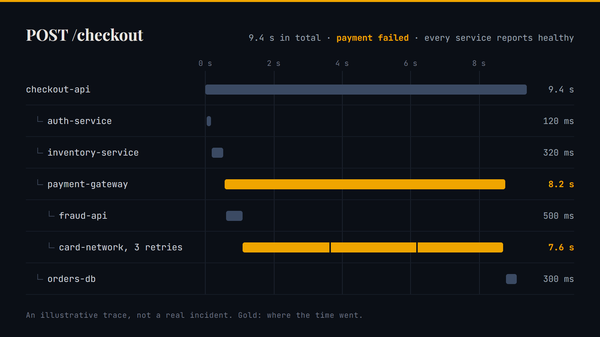
A single user request may traverse 10–20 services. Tracing failures requires sophisticated distributed tracing tools (Jaeger, Zipkin) and even then, root cause analysis can take hours.
Data consistency
With each service owning its database, maintaining consistency across services requires sagas or eventual consistency patterns — introducing bugs that wouldn't exist in a monolith.
Network latency
What was a function call in a monolith becomes an HTTP request with serialization, network hops, and deserialization. Latency compounds across service chains.
Deployment complexity
Coordinating deployments of 50+ services with interdependencies requires sophisticated CI/CD, canary releases, and feature flags.
Testing nightmares
Integration testing across services requires contract testing, service virtualization, and staging environments that mirror production.
Operational overhead
Each service needs its own monitoring, alerting, logging, scaling rules, and on-call rotation. The operational surface area grows linearly with service count.
8. Solutions for Large Enterprises
The answer isn't to abandon microservices wholesale — it's to apply them strategically. Here's what leading organizations are doing:
Strategy 1: The Modular Monolith
A modular monolith is a single deployable application with strict internal module boundaries based on domain logic. Each module encapsulates its own business logic and data access, communicating through well-defined internal APIs. The key difference from a traditional monolith is enforced separation — modules cannot reach into each other's internals.
This approach gives you 80% of the architectural clarity of microservices with 20% of the operational complexity. Shopify runs one of the world's largest modular monoliths, processing billions of dollars in transactions.
Strategy 2: Domain-Oriented Architecture (DOMA)
Pioneered by Uber, DOMA groups related microservices into larger domain-level units. Instead of 2,000 individual services, you have perhaps 50 domains, each with a clear owner, a well-defined interface, and internal freedom to organize as needed. This reduces cross-team coordination while preserving service-level independence where it matters.
Strategy 3: Start Monolith, Extract When Needed
The pragmatic approach: begin with a well-structured monolith. Monitor real usage patterns. When a specific module genuinely needs independent scaling, separate deployment cadence, or a different technology stack — extract it into a service. This evidence-based decomposition avoids the trap of premature splitting.
Strategy 4: Platform Engineering Investment
Companies that succeed with microservices at scale (Netflix, Google, Amazon) have invested heavily in internal developer platforms that abstract away operational complexity. If your organization can't afford a dedicated platform team, microservices at scale are probably not the right choice.
9. Where Is the Industry Heading?
The conversation in 2026 has matured significantly. The binary "monolith vs. microservices" debate has given way to a spectrum of architectural patterns, each appropriate for different contexts:
Approach
Best For
Avoid When
Traditional Monolith
Small teams, MVPs, startups, simple domains
You have 100+ developers or drastically different scaling needs across modules
Modular Monolith
Mid-size teams, most business applications, complex domains with shared data
You genuinely need polyglot persistence or independent scaling per module
Selective Microservices
High-scale systems with clear domain boundaries and dedicated platform teams
You're under 20 engineers or your domain boundaries are still evolving
Serverless / FaaS
Event-driven workloads, sporadic traffic, glue logic between systems
You need sub-millisecond latency or have long-running processes
The biggest shift is philosophical: architecture is no longer chosen based on industry trends or conference talks — it's chosen based on team size, organizational structure, operational maturity, and actual scaling requirements. The question has changed from "should we use microservices?" to "at what point, if ever, do we need to extract services from our well-structured monolith?"
AI and ML workloads are also reshaping the landscape. Many AI inference pipelines benefit from tightly coupled, GPU-optimized monolithic services rather than distributed microservices with network overhead between model components.
10. The Final Verdict
Microservices were never the problem. Applying them indiscriminately was.
Microservices are a powerful architectural pattern that solved real problems for organizations operating at massive scale with mature engineering teams. Netflix, Amazon, and Google genuinely needed them — and still use them. The mistake was treating microservices as a universal best practice rather than a tool for specific problems.
For the majority of organizations — those with fewer than 100 engineers, moderate traffic, and evolving domain models — a well-structured modular monolith is the right starting point. It's simpler to develop, cheaper to operate, easier to debug, and can be decomposed into services later if concrete evidence warrants it.
The mature engineering answer in 2026 is not "monolith or microservices" — it's "start simple, measure everything, and evolve your architecture based on real constraints, not hypothetical ones."
AIIQLabs | IT Training Courses — AI, DevOps & Engineering
India & Online | aiiqlabs.com
Take the next step
Build and ship microservices. With confidence.
Move beyond theory — our DevOps and Spring Boot Microservices courses cover containers, orchestration, service design, and real deployment pipelines, taught live by practitioners.
● LIVE COHORTS● CERTIFICATE OF COMPLETION● PRIVATE DISCORD COMMUNITY● 1-ON-1 MENTORING
Disclaimer
This article is intended for educational and informational purposes only. All product names, logos, trademarks, and registered trademarks mentioned herein — including but not limited to Spring Boot, Spring Cloud, Docker, Kubernetes, AWS, Amazon Web Services, Google Cloud Platform, Microsoft Azure, Netflix OSS, Istio, Apache Kafka, Redis, and others — are the property of their respective owners. AIIQLabs is not affiliated with, endorsed by, or sponsored by any of the vendors or organisations mentioned in this article.
Performance benchmarks, adoption figures, and pricing information cited are approximate, based on publicly available sources as of April 2026, and may vary significantly based on deployment configuration, cloud provider region, and licensing terms. Readers should consult the respective vendors directly for current and accurate information before making architectural or procurement decisions.
The opinions expressed represent the author's analysis of publicly available information and industry trends. They do not constitute professional advice, and readers should perform their own due diligence when evaluating microservices architectures and tooling for their specific requirements.