By aiiqlabs.dev · August 2026
1. The Midnight Terminal: A Visceral Reality
The blue light of a terminal at 2:00 am has become the unofficial spotlight of the modern job search. Across the global tech landscape, thousands of engineers are locked in a silent, exhausted marathon: consuming tutorials at 1.5x speed and collecting digital badges like tally marks on a prison wall. There is a desperate, unspoken contract in play: if I finish this curriculum, I will be rewarded with a role.
It is a lie. The strategic reality of the "effort-reward" contract has fundamentally shifted, and the psychological impact of the automated rejection email—arriving mere minutes after a meticulously polished application—is hollowing out the industry's spirit. We are witnessing a massive devaluation of the digital badge. In a saturated market, a certification is a low-resolution signal. It proves you can follow a paved path, but it says nothing about your ability to survive the woods. The digital badge has become a devalued currency because the industry has stopped hiring for what you know and started hiring for what you can endure.
The individual's internal struggle against burnout is real, but the external mechanics of the hiring market are indifferent to effort; they only respond to the hard geometry of capability.
2. The Fallacy of the Reward: Why a Job is a Bet, Not a Prize
The "single-skill trap" is the most dangerous tactical error a professional can make today. It is built on the fallacy that a job is a trophy for finishing a syllabus. In reality, a company does not hire you to "do Kubernetes" or "do AI."
A job is a high-stakes bet. When a company extends an offer, they are wagering that you can absorb a messy, under-specified problem—the kind that doesn't have a "Next Lesson" button—and return a solution that actually works.
A single skill, studied in isolation, is knowledge; capability is evidence.
The curriculum is bounded and predictable, while the job is unbounded and chaotic. This distinction dictates every hiring outcome: the market is moving away from "nouns" (the names of tools) and toward the "seams" where those tools meet the messy reality of business.
The proof of this shift isn't just a feeling—it's written in the cold geometry of the 2026 hiring data.
3. The Cold Geometry of the Market: Decoding the Data
Navigating the current landscape requires moving beyond gut feeling and into data-driven career planning. The 2026 market data reveals a striking disconnect between what candidates study and what employers require to take the "bet."
- The Capability Gap: A study of 566 software job posts found that nearly every listing required non-technical skills, averaging more than six per posting.1
- Preferred vs. Required: An analysis of 121,788 software engineer listings in 2026 showed that tools like Docker, Kubernetes, and AWS—the very things people spend weekends certifying in—were more often listed as "preferred" than "required." Meanwhile, "problem-solving" was a hard requirement in 24,000 listings, and "communication" appeared in a third of them.2
- The AI Multiplier: While white-collar hiring grew by a modest 5%, the July 2026 Naukri JobSpeak index showed Indian AI/ML hiring surging by 33% year-on-year.4 This demand is not for AI specialists in a vacuum, but for those who can attach the model to an existing stack and business.3
- The Bengaluru Composite: Consider a standard mid-level SRE listing in Bengaluru. It asks for 11 distinct capabilities: Cloud (AWS), a language, Postgres, Kafka, Tracing/OpenTelemetry, Dashboards/Alert Design, On-call, Design Docs, Incident Prioritisation, Stakeholder Management, and Mentoring. The "observability" course you took last month covers exactly two: Tracing / OpenTelemetry and Dashboards & alert design.
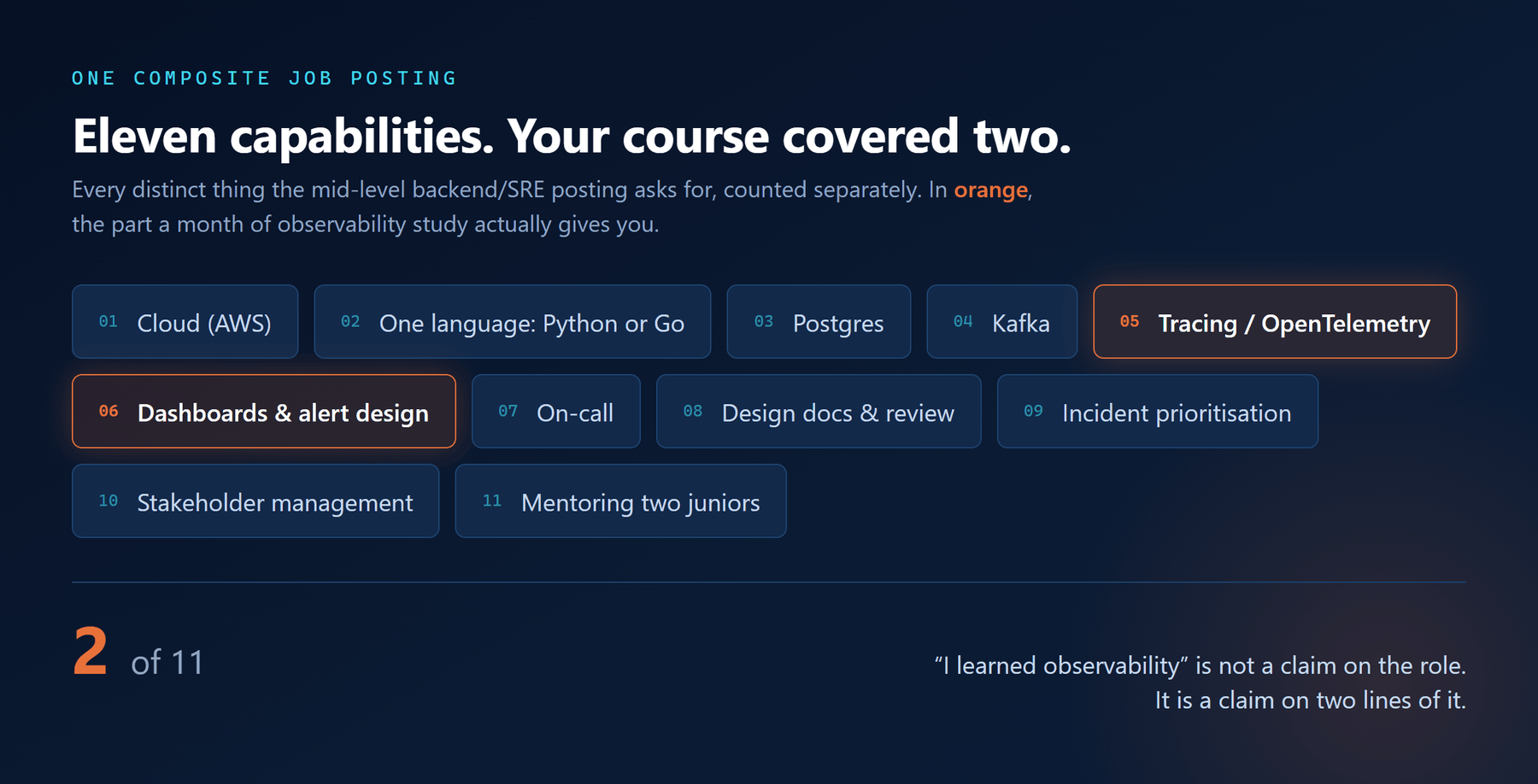
For the "weekend certifier," the message is clear: the tool is the minor part. Employers are looking for the eighty percent of the work that exists at the seams between the tools—the parts that can't be taught in a 30-hour video series.
4. The Architecture of Capability: The T-Shaped Professional
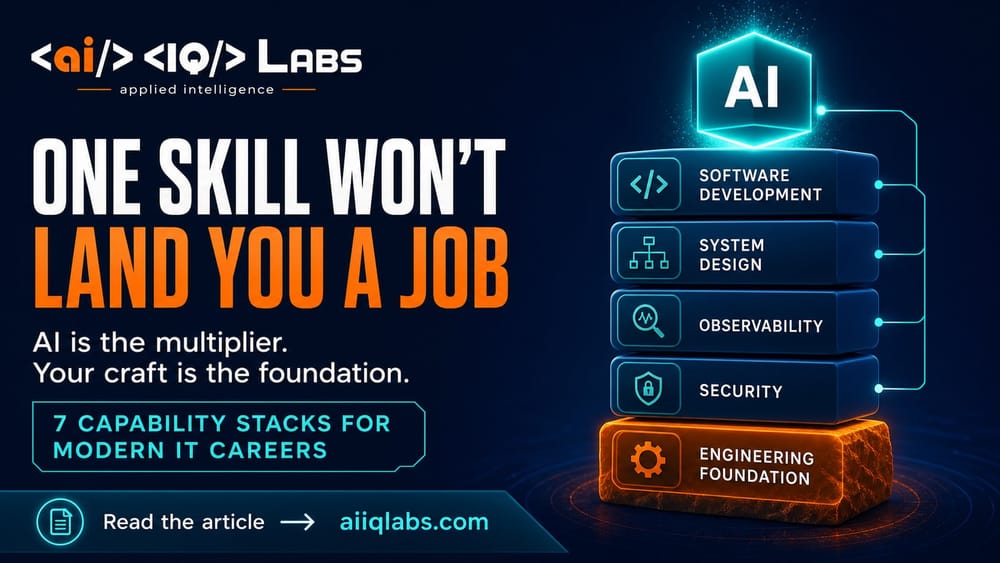
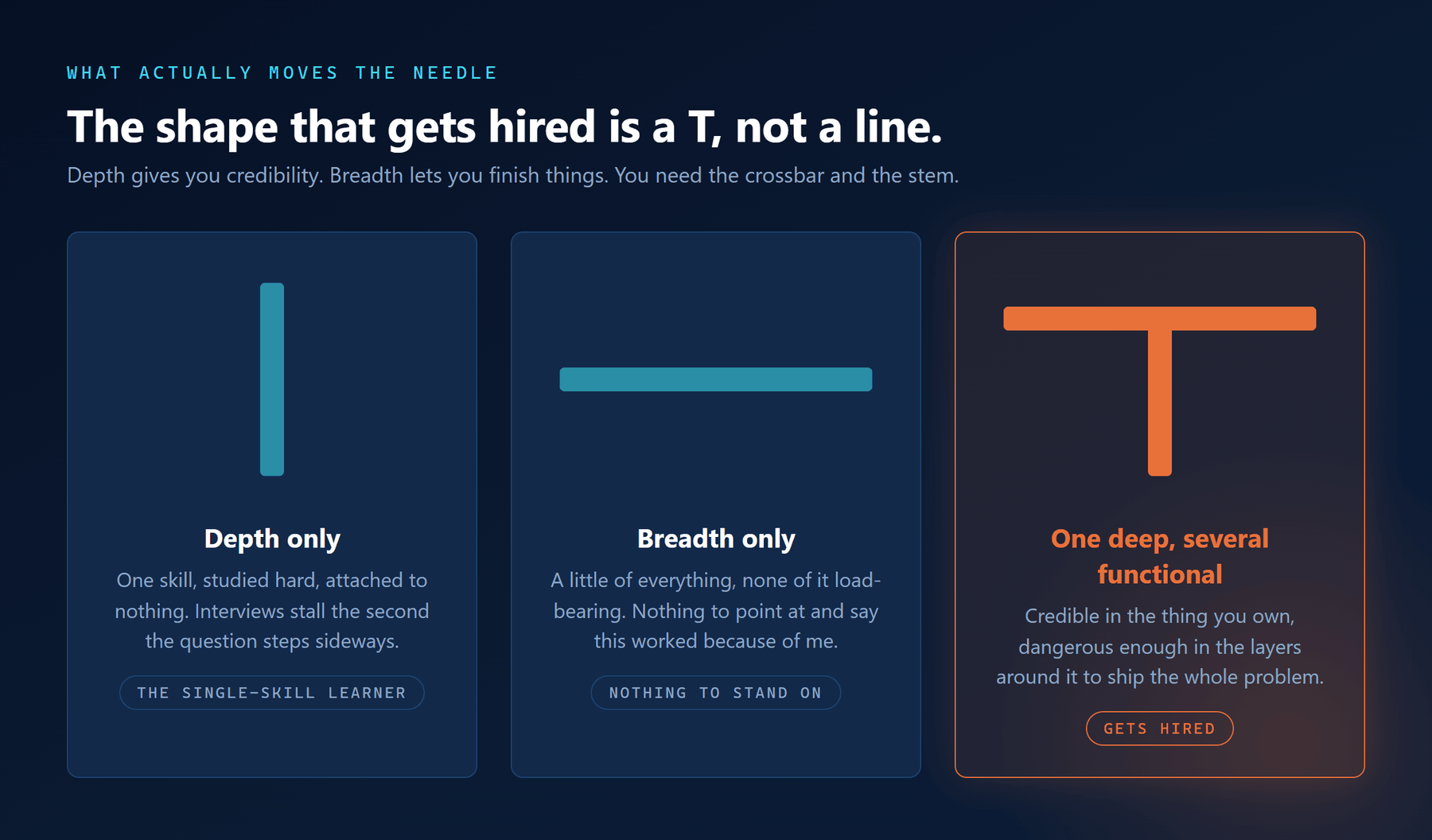
To survive this shift, one must adopt the "T-Shaped" profile. Depth (the vertical stem) gives you the credibility to enter the room, but breadth (the horizontal crossbar) is what actually allows you to finish a project.
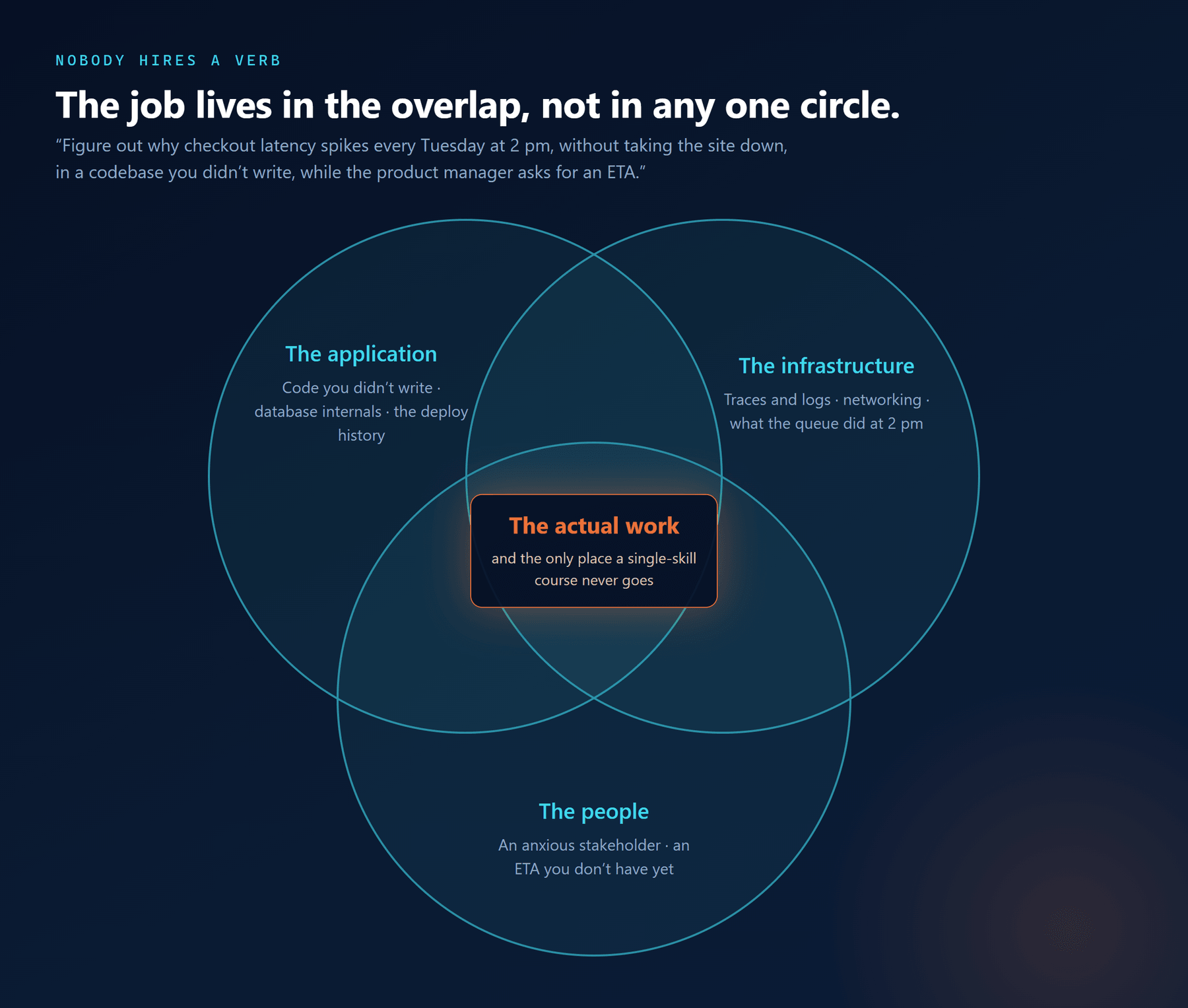
The "Actual Work" lives in the overlap. Using a Venn diagram logic, it is the intersection of The Application (the code you didn't write and the deploy history), The Infrastructure (the networking, traces, and what the queue did at 2 pm), and The People (the anxious stakeholder asking for an ETA you don't have yet).
Depth alone makes you fragile; if your one skill is replaced by an automated tool, you have nothing left to stand on. Capability stacks, however, are harder to automate and more valuable to buy because they allow a professional to own the whole problem, not just a single ticket.
5. The Seven Blueprints for the Modern Engineer
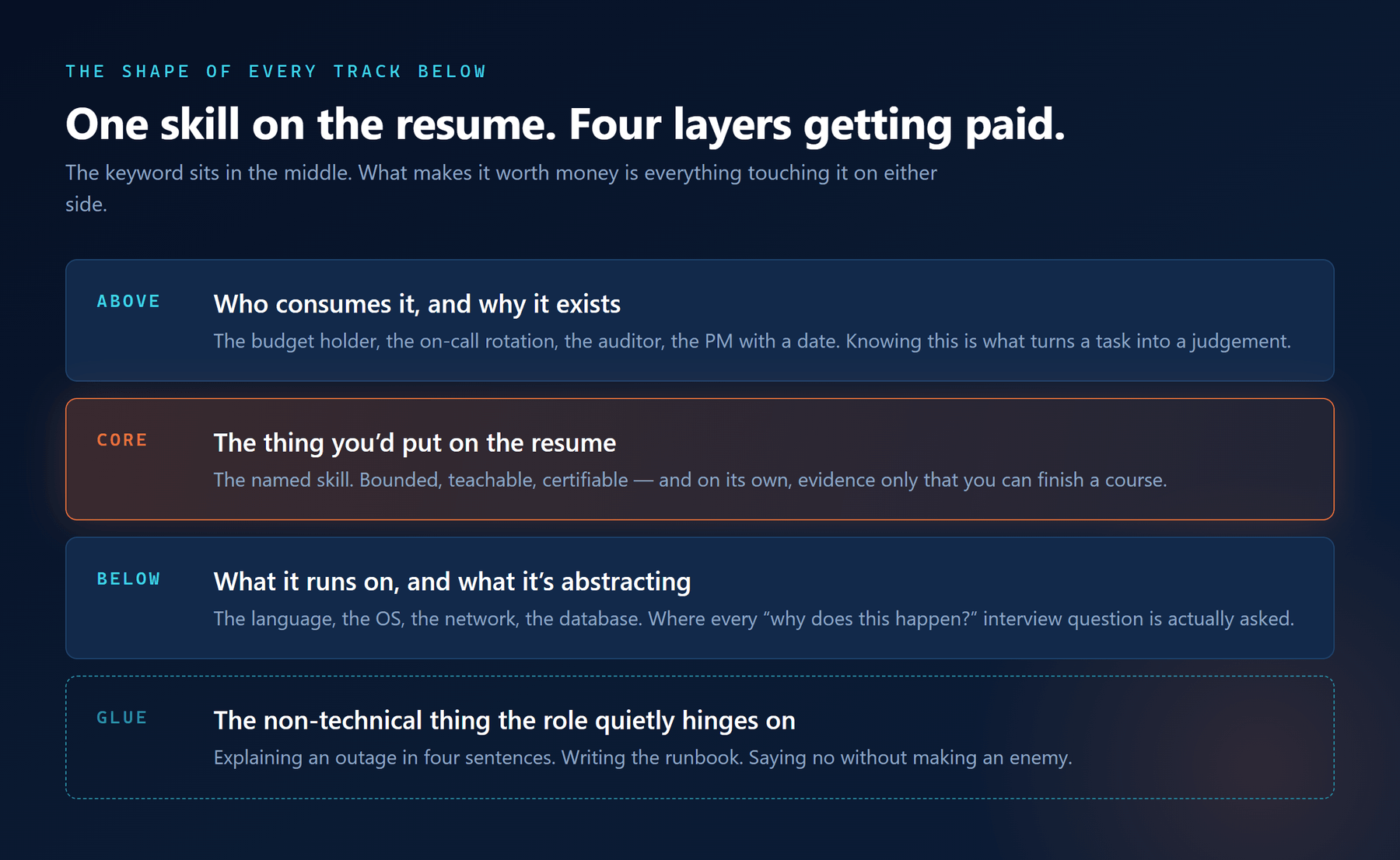
These tracks are not curricula; they are combinations of survival. They are designed to mirror how the job actually sees a person: as a solution to a specific, expensive business pain.
6. The Uncomfortable Horizon: A Dramatic Climax
Single-skill learning is popular for one reason: it is finite. It has a progress bar. It is comfortable because it stays within the lines of a pre-set curriculum. But real capability is unbounded and messy. It is found in the "unnamed" skills—the eighty percent of the work—that carry the weight of a professional role.
The reason most people haven't done this work yet is that it doesn't come with a certificate. It doesn't come with a green checkmark. It only comes with the discomfort of being out of your depth at the seams.
If a course can fully prepare you for a role, the role doesn't actually need a human—it needs an algorithm. We are currently building the very tools that will automate the "nouns" of our industry. When that automation is complete, the only people left standing will be those who understood the seams, the trade-offs, and the human cost of the systems they built.
Look at your current toolkit. Ask yourself: When the automation we are building is done, what will be left of the person who only knew how to run the tool?
You are standing at the blank terminal. The progress bar is gone. What do you build now?
7. Sources & Footnotes
- Rabelo et al., “The Role of Non-Technical Skills in the Software Development Market,” ACM, 2022.
- Huntr, “Software Engineer Skills: 121,788 Job Posts Analyzed,” 2026. publisher
- The Interview Guys, “10 Must-Have AI Skills for Your 2026 Resume,” June 2026, citing McKinsey and LinkedIn Jobs on the Rise data. publisher
- Naukri JobSpeak Index, July 2026, Info Edge (India). publisher
Disclaimer
This article is an editorial opinion piece about hiring and career strategy. It is not career, recruitment, employment, financial, legal or educational advice, and it is not a placement offer or guarantee of any kind. Nothing here should be treated as a prediction about any particular employer, role, market or individual outcome.
The mid-level SRE listing described as "the Bengaluru Composite" is exactly that — a composite, assembled from the recurring shape of backend and SRE listings in Indian tech hubs. It is not a reproduction of, and does not refer to, any single employer's advertisement. The count of eleven capabilities is our reading of that composite, not a standardised measure.
The seven blueprints are planning guides, not curricula and not a syllabus for any AIIQLabs programme. The layers, execution plans, proof artifacts and interview questions are illustrative of how such roles are commonly scoped; they will not match every employer, and no combination of them guarantees an interview, an offer, a salary or a role. Hiring outcomes depend on market conditions, location, experience, timing and the quality of what you build — none of which any article or course controls.
Figures are quoted as reported by the sources listed above and have not been independently verified by us: Rabelo et al. on non-technical skills (ACM, 2022); Huntr’s analysis of 121,788 postings (2026); AI skills demand as summarised by The Interview Guys citing McKinsey and LinkedIn (June 2026); and the Naukri JobSpeak index (Info Edge, July 2026). Methodologies differ between these sources and the figures are not directly comparable with one another. Where the sources list links to a publisher homepage rather than the item itself, we were unable to verify a direct link and readers should locate the original there; the “Bengaluru Composite” carries no citation because it is our own construction, not a finding from any of them. Labour-market data dates quickly — do not base hiring, study or career decisions on these numbers without checking their current state against the primary sources.
Product, tool and company names — AWS, Kubernetes, Splunk, Grafana, Terraform, Playwright and the rest — are the trademarks of their respective owners, used here descriptively. Their mention is neither an endorsement by us of them, nor by them of us, and implies no affiliation or partnership.