We chased the cloud. We forgot we owned the sky. A story about Arjun in Pune, Isabela in São Paulo, Hiroshi in Kyoto, and Amara in Nairobi — and the hardware sitting idle on all of our desks.
a
aiiqlabs academy
·12 min read
Arjun in Pune. Isabela in São Paulo. Hiroshi in Kyoto. Amara in Nairobi. Four people. Four kinds of knowledge. One machine that was always ready — sitting idle on a desk, waiting to be asked."
/>
Arjun in Pune. Isabela in São Paulo. Hiroshi in Kyoto. Amara in Nairobi. Four people. Four kinds of knowledge. One machine that was always ready — sitting idle on a desk, waiting to be asked.
By The Absent Minded Professor · April 2026
We chased the cloud. We forgot we owned the sky.
There is a man named Arjun in Pune.
He is 34. He is brilliant. He has spent eleven years mastering full-stack development — React, Node, MongoDB, the whole cathedral of modern software. He has built systems that process millions of transactions. He has debugged code at 3am while his daughter slept in the next room. He knows things that universities don't teach and bootcamps can't fake.
Last year, Arjun decided to give it back.
He would create a tutorial series. Complete. Thorough. The kind he wished existed when he was starting out. He set up his mic, his screen recorder, his notes. He recorded his first video on a Monday. It was good. Really good.
He recorded three that week.
Then life happened. A sprint deadline. A sick child. A power cut. A week became two. By the time he returned, he had six videos. He needed two hundred.
He did the math one night — the kind of math that breaks something quietly inside you.
At three videos a week, it will take me fourteen months to finish. But in fourteen months, half of what I recorded in month one will be outdated. React 18 will be React 19. Express middleware patterns will have shifted. The MongoDB aggregation pipeline syntax I explained in video 4 will have a cleaner alternative that makes me look like I'm teaching from a history book. I will be building a staircase that collapses behind me as I climb.
Arjun closed his laptop. He didn't open it that night.
The obvious answer came quickly. Everyone had it ready.
Use AI. Use ElevenLabs for the voiceover. Use a script generator. Automate the production pipeline.
Arjun looked into it. He is methodical — the kind of developer who reads documentation before asking questions.
ElevenLabs: a five-minute video costs roughly $5 in TTS credits at professional quality. Two hundred videos, averaging eight minutes each — that's $1,600 in voice alone. Then a video synthesis tool — Synthesia or HeyGen — another $30 to $80 per month, with per-video costs above a certain volume. An LLM API for script generation — GPT-4o at roughly $5 per million output tokens, multiplied across two hundred detailed technical scripts. A rendering pipeline — compute time, storage, a CDN to serve the output. A thumbnail generation tool. A chapter and transcript tool for SEO.
He built a spreadsheet. He is a developer. He builds spreadsheets.
The number at the bottom was not outrageous. It was worse than outrageous. It was just plausible enough to be demoralising. Somewhere between $400 and $800 a month, sustained, before a single rupee of revenue. In a market where a complete MEAN stack course sells for ₹499 on a discount day.
He stared at the spreadsheet the way you stare at a locked door when you've already lost the key.
Halfway across the world, in São Paulo, there is a woman named Isabela.
She is a doctor. Fifty-one years old. She has spent two decades working in communities where the nearest specialist is four hours away and Google is a luxury, not a resource. She has developed diagnostic intuitions that no textbook contains — patterns in presentation, combinations of symptoms, things she learned not from journals but from sitting with patients in rooms with no air conditioning and making decisions with incomplete information.
She carries a library in her head that could save lives.
Last year, a young NGO worker suggested she document it. Turn it into a resource. A guide. Something the community health workers could use.
Isabela laughed. Not unkindly. But the laugh of someone who has been proposed the impossible before.
I see forty patients a day,* she said. *When do I write the book?
The NGO worker had no answer.
The library stays locked inside Isabela's head. Every morning she opens the clinic. Every evening she closes it. The knowledge flows through her hands and voice and eyes — and nowhere else.
And here is the technical reality that nobody in that conversation named: what Isabela carries in her head is, in machine learning terms, a classification model trained on 20 years of labelled data. Every patient she has ever seen was a data point. Every diagnosis, a label. Every follow-up, a feedback loop that updated her internal weights.
The model exists. It is running. It is accurate.
It just has no API. No documentation. No export function.
And its only instance will eventually go offline — permanently.
Somewhere in those forty patients a day, there is a case that a community health worker three villages over will misdiagnose next Tuesday. Isabela would have caught it in thirty seconds. But Isabela won't be there.
In Kyoto, there is an old man named Hiroshi.
He is seventy-three. He builds wooden joinery — the kind that holds temples together without a single nail. Mortise and tenon. Kigumi. Joints so precise that thermal expansion and contraction over centuries becomes a feature, not a fault. His father taught him. His father's father taught his father. The knowledge is in his hands now, literally — in the calluses, in the muscle memory, in the way he tilts a piece of wood and reads it like a sentence.
His son is a software engineer in Tokyo. His daughter is in Vancouver.
Nobody learned the joinery.
Hiroshi doesn't talk about this much. But sometimes, when he finishes a piece and runs his hand across the joint — a joint that will probably outlast everyone in the room — there is something in his face. Not pride exactly. Something older than pride. Something closer to grief.
He is not just a man getting old.
He is a civilisation's last hard drive, running without redundancy, with no snapshot, no backup, no replication strategy.
One failed heartbeat away from total data loss.
Now.
Let's talk about what happened next — in a world slightly different from ours. A world where someone, somewhere, asked a different question.
Not how do we use AI to replace this?
Not how much will it cost to automate this?
But simply — what do we already have?
A developer — nobody famous, no VC funding, no launch on Product Hunt — sat in her apartment in Nairobi. Her name was Amara. She had a laptop that was three years old. An AMD Ryzen 7. 16 gigabytes of RAM. A 512GB SSD that was 70% full. No remarkable internet connection — 10 Mbps on a good day, shared with two flatmates.
What she had — in abundance — was frustration.
She was tired of the conversation.
Every solution she encountered required a subscription. Every tool assumed cloud access. Every framework was built for San Francisco, priced for San Francisco, hosted in San Francisco — and then graciously made available to the rest of the world, for dollars, payable monthly, renewable annually.
She knew what her laptop could actually do. She had run the numbers. An AMD Ryzen 7 5800H — 8 cores, 16 threads, 4.4GHz boost. Capable of running quantised language models locally. Capable of real-time audio transcription via Whisper running entirely on-device. Capable of document processing, format conversion, template rendering, video assembly — all of it, offline, using only power from the wall socket she was already paying for.
She was not running any of that.
She was paying $18 a month for tools that used her data to improve themselves and called it a service.
So she asked the question differently.
What if AI's only job was to build the tool — and then get out of the way forever?
The architecture she designed was almost aggressive in its simplicity. A local Whisper model for transcription — open source, runs entirely on CPU, no API key required. A local LLM — a quantised 7-billion parameter model, small enough to run on consumer hardware, smart enough to structure and format knowledge from raw input. A processing pipeline written in Python that took raw material in any form: voice recordings, rough notes, video demonstrations, handwritten scans. And an output layer that produced whatever format the knowledge needed to become.
No data left the machine.
No subscription renewed at midnight.
No API usage spiked without warning.
Just a laptop. Doing what a laptop at full capacity, properly instructed, was always capable of doing.
She sent it to Arjun. Just to see.
Arjun fed it three of his videos. Some rough notes. A few code samples with comments still in them. He went to make chai.
The Whisper model transcribed the audio — accurately, preserving his code variable names and technical terminology without hallucinating synonyms the way cloud services sometimes did. The local LLM parsed the transcript, identified the teaching structure, extracted code blocks, cross-referenced his notes, and generated a formatted module — sections, subsections, code examples highlighted and indexed, a summary, a prerequisites block.
It used 6GB of RAM at peak. It ran in four minutes on hardware Arjun had owned for two years.
When he came back with his chai, the output was waiting.
He sat very still for a moment.
Then he called his wife into the room. Look at this, he said. He didn't have more words than that.
The module wasn't perfect. The LLM had misunderstood one analogy and structured a section slightly off. He corrected it in ten minutes. But the shape was right. The bones were right. And the cost of producing it — in dollars — was precisely zero.
He looked at his laptop differently after that. The way you look at something familiar when you realise you had completely misunderstood what it was.
Isabela received it differently.
She was skeptical. She had seen too many technology solutions arrive in her community with great fanfare and leave with greater silence — usually because they required a stable internet connection that the community did not have, or a server that the NGO could not maintain, or a license that expired when the grant funding did.
But the NGO worker persisted. They set up a session. Simple. A microphone. Isabela's voice. No forms to fill, no structured templates to constrain her — she just talked, the way she talked to her residents, unpolished and real.
The system listened. Whisper pulled clean text from her voice in real time, preserving her clinical shorthand. The local LLM — running entirely offline — structured her speech into a decision framework: presenting symptoms, differential diagnoses, red flags, referral triggers. Formatted into a protocol document.
Three weeks later, a community health worker in a village four hours from Isabela's clinic was looking at a child with a combination of symptoms she didn't recognise. She opened a guide on a tablet. No internet required — the document lived on the device. She found Isabela's protocol.
The child was referred in time.
Isabela never knew. She was seeing her fortieth patient of the day.
Hiroshi was the hardest.
He didn't want to talk to a machine. He didn't trust it. He didn't understand it and he didn't want to understand it — he was seventy-three and he had earned the right to refuse things he didn't understand.
But his granddaughter visited from Tokyo. She was fourteen. She set up a camera — her phone, nothing more — at a fixed angle in the workshop. She asked him to just work. Just build. Just be himself.
A computer vision model — running locally, processing frame by frame — tracked hand positions, tool angles, force application, the sequence of movements that constituted each technique. It didn't need Hiroshi to explain. It observed. It noted spatial relationships. It logged the order of operations. The local LLM synthesised observation into annotation — producing a visual manual: photographs, angle diagrams, step sequences, annotated with the system's interpretation of what it had witnessed.
Hiroshi reviewed it. He corrected seventeen annotations. He argued with three others and then, reluctantly, admitted the system was right.
Six months later, in a university workshop in Prague, a student of traditional woodworking opened the manual on her laptop. No internet. She was alone in the workshop at 7am.
She placed her chisel exactly where Hiroshi would have placed his.
She didn't know his name. She will never know his name.
But her hands — in that moment — carried something he had spent fifty years learning.
And it cost no one anything. Not anymore.
Here is what nobody is talking about.
The hardware already exists.
Right now, on desks and in bags and on kitchen tables across the world, there are machines running AMD Ryzen 7s and Apple M-series chips and Intel 13th-gen processors — hardware that can run quantised language models, transcribe speech in real time, process video frame by frame, generate structured documents, render formatted output — all of it, entirely offline, entirely owned, entirely free after the moment of purchase.
A modern laptop running a quantised Llama 3 8B model can process and structure knowledge at a speed no human writer can match. It uses under 8GB of RAM. It needs no API key. It sends no data anywhere. It runs on the same electricity that charges your phone.
We are not using it for this.
We are using it to scroll.
And we are paying subscription fees — monthly, annual, per-token, per-minute, per-render — to rent intelligence from data centres in Virginia and Oregon and Dublin, on hardware that is also just silicon and copper and electricity, except it belongs to someone else.
We bought the land. We are renting a garden.
Because a word arrived. Loud, electric, blinding with promise. AI. And we looked up at it the way humans always look up at things that shine — and we measured ourselves against it and found ourselves insufficient. We calculated what we couldn't afford. We felt the particular modern despair of knowing that the future exists but carries a price tag denominated in dollars, payable to a handful of companies incorporated in a handful of zip codes.
We forgot to look at the machine on the desk.
We forgot that intelligence is not only in the cloud.
We forgot that we already own something extraordinary — and we have been leaving it idle, running at 10% capacity, while we debate whether we can afford the API.
The shackles are not economic. Not entirely. They are psychological.
We have been trained — by product launches and keynote addresses and breathless coverage — to believe that the frontier is always somewhere else. Always behind a login. Always one subscription away.
AI built the tool. Then it stepped aside.
The human fed the knowledge. Then lived their life.
The hardware did the rest. Quietly. Locally. Free.
No pricing model changed overnight and broke everything. No terms of service updated in a way that now owns a piece of what you made. No data crossed a border it wasn't supposed to cross. No server went down during the moment someone needed it most.
Just a machine. At full capacity. Finally.
Working for us. Not the other way around.
Arjun finished his tutorial series. Not in fourteen months. Not in the race against obsolescence he had mapped out on that quiet Tuesday night. When React released a major update, he recorded a fifteen-minute correction, fed it into the system, and went to sleep. By morning, every affected module had been updated, cross-references corrected, code examples refreshed.
He is now building his second series. He has stopped looking at pricing pages.
Isabela still sees forty patients a day. But now her knowledge sees forty thousand — in villages she has never visited, in languages the system translated her protocols into, on devices that have never connected to the internet.
Hiroshi passed away last spring. Quietly, in the same workshop where he had worked for fifty years. His tools are still there. His granddaughter keeps them oiled.
But his hands are still teaching. In Prague. In Jakarta. In a woodworking school in Oaxaca where a teacher found the manual on a forum and printed it and pinned it to the wall.
Hiroshi never knew about Oaxaca.
And Amara?
Amara is still in Nairobi. Same apartment. Same three-year-old laptop — the Ryzen 7, still running, still at full capacity now, finally justified.
She hasn't launched anything. There is no product page. No press release. No funding round. No demo day. She turned down a conversation with an investor who found her work through a forum post — not out of stubbornness, but because she understood something he didn't yet:
The moment this has a business model, it stops being the thing it needs to be.
She is building. Slowly. Carefully. In the hours between midnight and 4am.
The architecture is almost complete. The pipeline runs clean. The local models are tuned. The output quality crossed a threshold last Thursday that made her sit back from her laptop and stare at the ceiling for a long time.
She thinks it is ready.
She has not yet decided what to do with that.
There are things in this world that, once released, cannot be recalled.
A protocol that saves a child in a village with no internet. A joinery technique in the hands of someone who never met its maker. A tutorial series that updates itself while its creator sleeps.
And somewhere — perhaps on a server, perhaps not, perhaps in a form that requires no server at all — a tool that could do this for anyone. For the farmer in Punjab who knows things about soil that no sensor has measured. For the grandmother in Thessaloniki who carries recipes that are also chemistry. For the mechanic in Lagos who can hear an engine the way Hiroshi could read wood.
For everyone who has knowledge the world needs and no infrastructure to carry it.
Amara's cursor is blinking.
The Ryzen 7 is running.
The city outside is quiet.
She is about to press enter.
What happens next — nobody knows.
Not even her.
But the machine is ready.
It was always ready.
We just forgot to ask it.
Stop renting. Start owning.
The knowledge to build what Amara is building already exists. You can learn it.
Local LLM integration, Python AI pipelines, and LLM API mastery — the exact skills behind the architecture described in this article. Live, instructor-led cohorts. Build real projects. Own everything you create.
● LIVE COHORTS● CERTIFICATE OF COMPLETION● PRIVATE DISCORD COMMUNITY● 1-ON-1 MENTORING
Disclaimer
This article is a work of speculative narrative non-fiction. The characters — Arjun, Isabela, Hiroshi, and Amara — are fictional composites created to illustrate a real concept. Any resemblance to actual persons is coincidental. Technical specifications referenced (AMD Ryzen 7 5800H, Whisper, Llama 3 8B, pricing figures for ElevenLabs and LLM APIs) reflect publicly available information at the time of writing and are used for illustrative purposes only. Pricing and model capabilities change frequently.
The views expressed are those of the author writing under the pen name "The Absent Minded Professor" and do not constitute technical or financial advice. The concept described — locally-run AI-assisted knowledge production tools — is a real and emerging area; specific implementations, capabilities, and limitations vary significantly by use case, hardware, and model choice.
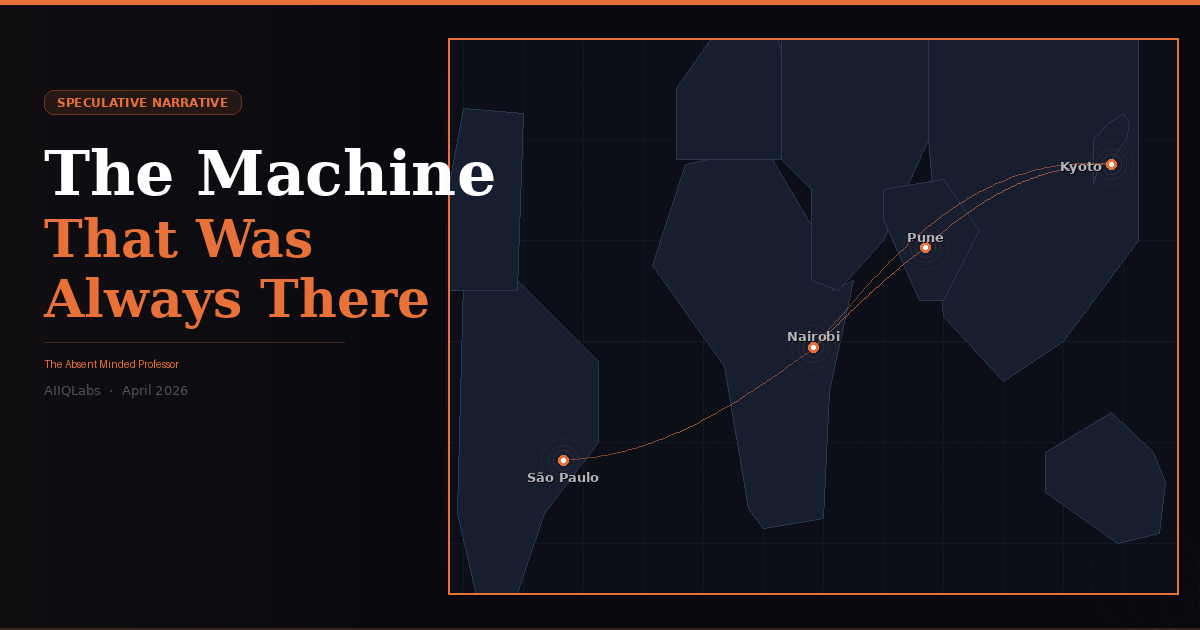 Arjun in Pune. Isabela in São Paulo. Hiroshi in Kyoto. Amara in Nairobi. Four people. Four kinds of knowledge. One machine that was always ready — sitting idle on a desk, waiting to be asked."
/>
Arjun in Pune. Isabela in São Paulo. Hiroshi in Kyoto. Amara in Nairobi. Four people. Four kinds of knowledge. One machine that was always ready — sitting idle on a desk, waiting to be asked."
/>